


If you work with small businesses long enough, you start to notice a pattern.
Not just in marketing results, but in how business owners think, operate, and grow.
At Marketing Sux, we’ve worked with companies at every stage imaginable. Startups with no direction. Established businesses that feel stuck. Operators who finally “get it” and start investing with intention. And companies that are ready to scale fast without blowing themselves up.
What we’ve learned is simple:
Marketing and business strategy aren’t just related. They move in parallel.
At a certain point, marketing is the business strategy.
Whether you’re a home services crew or an insurance agency, you likely fall into one of these stages. It’s okay to be where you are, as long as you understand what that stage actually means and where it naturally leads.
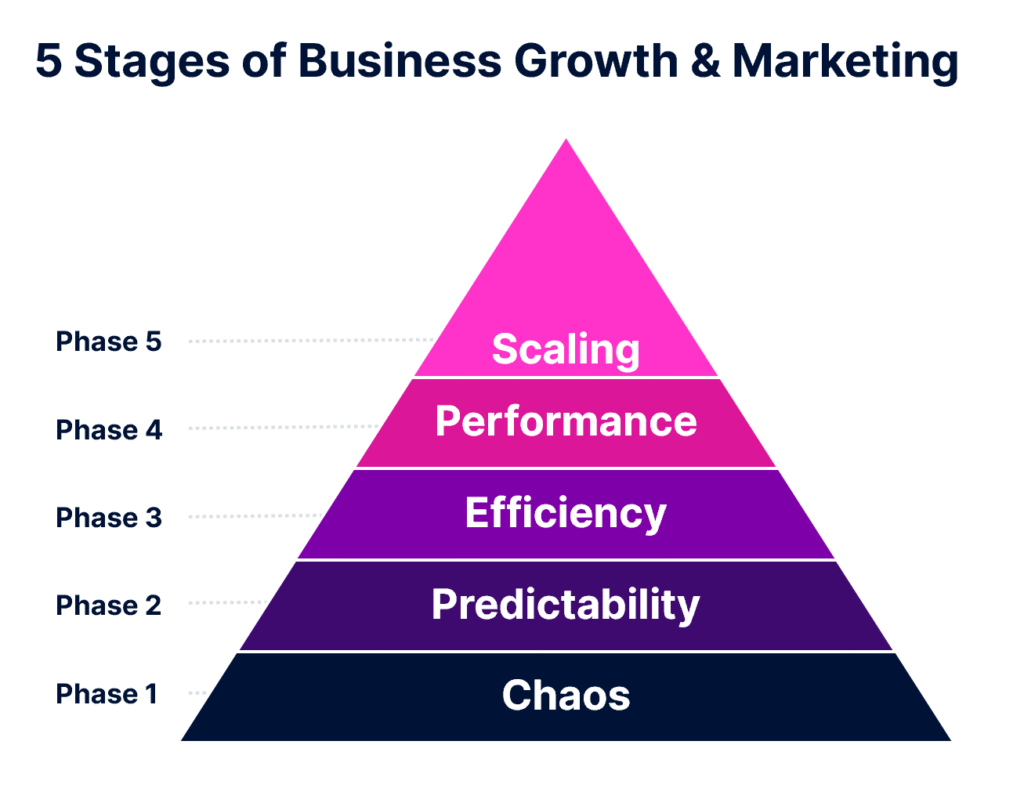
Phase 1: I’m Not Sure (Living in Chaos)
This is ground zero. And it’s the most dangerous place to be.
At this stage, the business itself is usually just as undefined as the marketing. Processes live in the owner’s head. Pricing changes on the fly. There’s no real budget — just money spent when things feel slow. Marketing decisions are reactive, emotional, and inconsistent because the business has no stable foundation yet. Marketing doesn’t fail here because of tactics — it fails because there’s nothing solid underneath it to support growth.
There is no real positioning yet. The message usually sounds like:
“We do X. We’re in Y industry.”
That’s it.
The Vibe
Generic. From the outside, there’s nothing memorable, nothing differentiated, and nothing that gives a customer confidence they’re making the right choice.
The Challenges
Customers are confused because they can’t tell what makes you different or better. Even if you spend money on ads or awareness, ROI is usually terrible. Not because marketing doesn’t work, but because the business itself isn’t clearly defined yet.
Marketing can’t fix confusion. It only amplifies it.
The Journey
Every business in this stage eventually hits the same wall. You start asking harder questions about who you’re really for, what you actually do best, and what you shouldn’t be doing at all. Until those answers exist, marketing feels expensive, risky, and disappointing. This phase ends when clarity finally shows up.
Phase 2: It’s Good Enough (Becoming Predictable)
This is where a lot of small businesses live for years.
Operationally, this business is functional but fragile. Some systems exist, but they aren’t documented or enforced. Lead handling varies depending on who answers the phone. Budgets are loosely defined and often pulled back when results aren’t immediate. Marketing mirrors this behavior — partially planned, inconsistently executed, and frequently paused just before it has time to work.
You’ve moved past being invisible. You care about your logo, your website, and how the business looks online. You’re doing real work. But growth feels capped.
The Vibe
Settling. The website is “fine.” The branding is “good enough.” Leads come in, but not consistently. You’re busy, but something feels off.
The Challenges
Stagnation. Processes are half-built. Lead handling is inconsistent. Sales follow-up depends on mood or availability. Marketing exists, but it’s reactive instead of intentional.
The business survives, but it doesn’t scale.
The Journey
Eventually, frustration builds. You realize that “not broken” isn’t the same as working. This is when owners start tinkering with marketing instead of committing to it. Some move forward. Many stay stuck here far longer than they should.
Phase 3: Let’s Do Things Better (Creating Efficiency)
This is the turning point.
This phase usually coincides with a shift inside the business. Owners start documenting processes, cleaning up lead handling, and paying attention to performance. Budgets become intentional instead of emotional. Roles get defined. Marketing finally has something to attach itself to — real systems, real tracking, and real follow-through. This is why marketing starts working here, not because it’s “better,” but because the business is finally ready to support it.
At this stage, business owners start to realize a few uncomfortable truths:
- They don’t have the time to do marketing themselves
- They don’t have the expertise to do it well
- Competitors who are growing are investing more intentionally
The Vibe
Experimental. You’re testing ads, agencies, platforms, and ideas. Some things work. Some don’t. At least you’re learning.
The Challenges
Learning the hard way. There’s a gap between “trying things” and “measuring things.” That gap can cost money, time, and patience.
The Journey
This phase is about setup, not perfection. You learn which channels actually produce leads, what growth really costs, and why tracking matters. By the end of this stage, proof matters more than promises, and data starts driving decisions instead of gut feelings.
Phase 4: Let’s Optimize (Maximizing Performance)
This is what real success looks like.
By this point, the business runs on systems instead of personalities. Lead flow is predictable. Staffing levels are intentional. Budgets are planned annually, not month-to-month. Because the business is stable, marketing becomes less stressful and more strategic. Changes are tested, measured, and refined instead of guessed at. Marketing doesn’t feel risky anymore — it feels controllable.
Not hype. Not chaos. Stability.
The Vibe
Predictable and controlled. You know who you are, what you sell, and where your leads come from. Budgets are planned. Results are tracked.
The Challenges
Avoiding complacency. The question is no longer “Does this work?” but “How do we make it work better without breaking the business?”
The Journey
Marketing becomes a system instead of a gamble. Optimization replaces experimentation. ROI becomes the focus. This is where marketing finally feels boring in the best possible way.
Stage 5: It’s Working (Scaling Up)
This stage is optional, but powerful.
At this stage, growth is no longer accidental. New markets, services, or locations are launched using proven playbooks. Budgets scale alongside revenue, not in panic. Marketing becomes a lever that management pulls intentionally, backed by data and process discipline. The business isn’t hoping marketing works — it already knows how and why it does.
Not every business wants it. Some owners are happy to coast or prepare for selling their business. Others see opportunity.
The Vibe
Confident and intentional. You’re no longer guessing. You’re choosing.
The Challenges
Scaling introduces new complexity. New markets, new teams, and new risks. Growth requires discipline, not just ambition.
The Journey
At this stage, growth is deliberate. Expansion is based on proven systems, reliable data, and experience. Marketing becomes a lever you pull on purpose, not a fire you’re constantly putting out.
The Big Takeaway
Marketing investment almost always follows a mindset shift.
As business owners mature, they stop asking:
“Can I afford marketing?”
And start asking:
“What happens if I don’t invest in it?”
Marketing doesn’t replace good operations. It reveals them.
It doesn’t fix broken businesses. It exposes them.
And when done right, it becomes one of the strongest drivers of long-term growth, stability, and business value.
Where Do You Fit?
If you’re honest about where your business is today, the next step usually becomes obvious.
Build it yourself. Tighten your systems. Or get help from people who’ve seen this journey from every angle.
That’s what we do.
And yeah, marketing still sucks.
It just sucks a lot less when it’s done right.